
Planning
A Kitchen for Chinese Cooking in Bellevue, WA: Hoods & Woks
Planning a kitchen for wok cooking? See which range hood works, how much CFM you need, Washington's venting rules, makeup air, and gas vs. induction.
By Shawn, True Level Remodeling阅读中文版
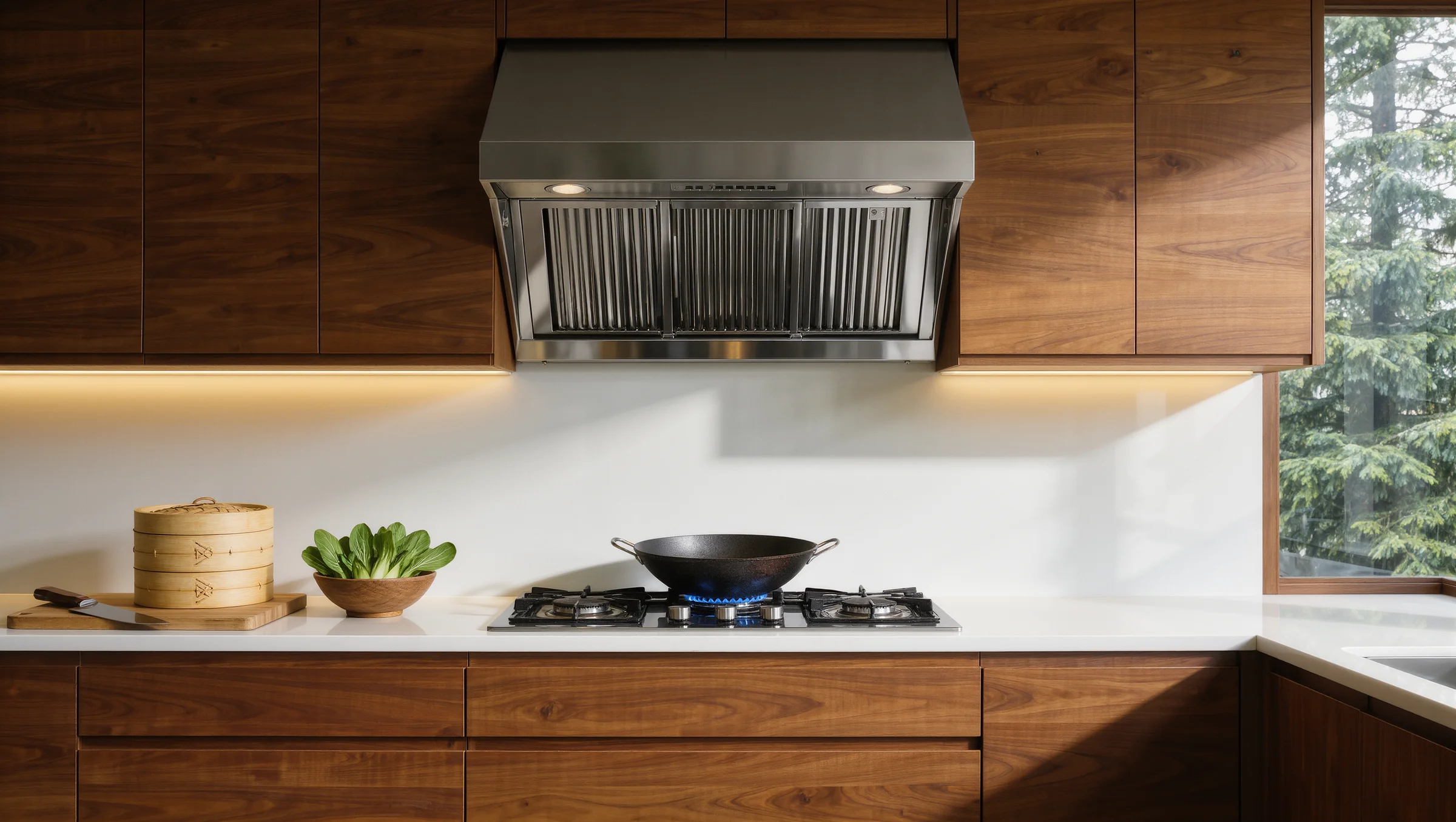
A kitchen for Chinese home cooking starts with the range hood, not the cabinets. High-heat wok cooking, deep-frying and steaming put far more smoke, oil mist and moisture into the air than most American cooking. So the hood should be ducted to the outside, wider and deeper than the cooktop, and sized for the airflow you’ll really use. A large hood can also mean planning for makeup air.
Settle these early in design, because the duct route, the electrical work and the cooktop all depend on them.
What makes Chinese cooking hard on a kitchen?
Stir-frying at high heat throws oil into the air as a fine mist. Some of it is caught by the hood; the rest settles on cabinets, ceilings and walls as a sticky film. Add steam from soups and steamed dishes, strong aromas, and the heat of a big burner, and an ordinary microwave-hood combination can’t keep up.
The goals are simple:
- Capture the smoke and grease before it spreads.
- Move it outside, not back into the room.
- Replace that air so the hood can do its job.
- Clean easily what does escape.
Which range hood works for wok cooking?
The shape and size of the hood matter as much as the fan. Here’s how common types compare for heavy, high-heat cooking. This is general guidance; the right choice depends on the kitchen layout.
| Hood type | For wok cooking | Why |
|---|---|---|
| Wall-mounted chimney or deep canopy hood | Best | A deep canopy holds the rising plume while the fan pulls it out |
| Hood insert built into custom cabinetry | Good, if deep enough | Same idea, hidden in a cabinet surround |
| Island hood | OK, needs more airflow | Air moves in from every side, so the plume drifts |
| Over-the-range microwave | Poor | Shallow, small fan, often recirculating |
| Downdraft vent | Poor | Pulls sideways against rising heat and smoke |
Features worth having: stainless baffle filters that go in the dishwasher, a hood at least as wide as the cooktop (wider is better), and a mounting height within the manufacturer’s range. Too high, and the smoke escapes around the edges.
How much CFM does a wok-cooking range hood need?
The Home Ventilating Institute (HVI) recommends 100 CFM per linear foot of range for a cooktop against a wall and 150 CFM per linear foot for one in an island, with minimums of 40 and 50 CFM per foot (HVI, range hood guidance, checked November 2026).
For a 36-inch (3-foot) cooktop, that works out to:
- Against a wall: about 300 CFM recommended
- In an island: about 450 CFM recommended
Many people who cook with a wok every day choose more. But a bigger fan only helps if the hood captures the smoke, the duct is the size the maker specifies, and the room can supply the air. Above about 400 CFM, the makeup air question below comes in. Noise rises too, so compare sone ratings at the speed you’ll actually use.
Does a range hood have to vent outside in Washington?
As a rule, yes. Washington’s residential code says domestic cooking exhaust “shall discharge to the outdoors through a duct,” with a smooth, airtight duct and a backdraft damper, and that it may not end “in an attic or crawl space or areas inside the building” (WAC 51-51-1503, M1503.3, checked November 2026). Listed ductless hoods are allowed only under a narrow exception, and they don’t remove smoke and moisture from the house anyway.
In a remodel, the duct route is the decision to make first. A short, straight run through an exterior wall or the roof works best. A long run with several elbows cuts the hood’s real airflow.
Do you need makeup air for a big range hood?
Possibly. Makeup air is fresh air brought in to replace what the hood removes. Without it, a powerful hood can starve itself and pull air, or exhaust gases, from elsewhere in the house.
Codes link the requirement to hoods able to move more than 400 CFM. In the 2021 Seattle Residential Code, for example, makeup air is required for those systems “where one or more gas, liquid or solid fuel-burning appliance that is neither direct-vent nor uses a mechanical draft venting system is located within a dwelling unit’s air barrier”: think an older gas water heater with a draft hood, or an open wood fireplace (Seattle Residential Code 2021, Chapter 15, checked November 2026).
Because codes and local amendments change, confirm the requirement for your house during permit review. If makeup air is needed, it’s usually a duct from outside with a motorized damper that opens when the hood runs. It’s far easier to plan before the drywall goes up.
Gas wok burner or induction?
Both can work. It’s a cooking preference as much as a technical choice.
- Gas gives the open flame many cooks want for a round-bottom wok, and some ranges offer a dedicated high-output wok burner. Moving or adding a gas line needs a permit; our Bellevue permit guide explains when.
- Induction heats very fast with less waste heat in the kitchen. It works with a flat-bottom wok, or with induction units made for round-bottom woks. It needs a dedicated circuit, so check the electrical panel’s capacity early, especially in an older house. See remodeling an older Bellevue home.
Either way, size the hood for how you actually cook, not for the cooktop label.
Should you add a separate wok kitchen?
Some homeowners add a small enclosed “wok kitchen” or “spice kitchen” next to the main kitchen, with its own cooktop and hood, so the heavy cooking stays behind a door. It keeps the open kitchen clean, but it needs its own duct to the outside, more electrical and plumbing work, and space. A second full kitchen can also raise zoning questions in some cities, so ask early in design.
Which surfaces are easiest to keep clean?
What the hood misses ends up on surfaces. Choose ones that wipe down:
- A full-height backsplash behind the cooktop in quartz, porcelain slab or large-format tile with few grout lines
- Closed cabinets with smooth fronts near the cooktop, not open shelving
- No textured or flat-painted ceilings near the range
- Good task lighting under the hood, so you can see what you’re cooking and what needs wiping
Frequently asked questions
Is a ductless (recirculating) hood enough for Chinese cooking? No. Charcoal filters catch some odor, but smoke, grease and moisture stay in the house. Washington’s code expects cooking exhaust to go outside, with only a narrow exception for listed ductless hoods.
Is a higher-CFM hood always better? Not on its own. Capture area, a properly sized duct and makeup air matter as much as the fan rating. An oversized fan in a shallow hood is mostly noise.
Can I add a wok burner to my current kitchen? Often, but it may mean a new gas line or circuit and a bigger hood, and those usually need permits. Plan them together.
Plan your kitchen with us
We give free on-site estimates for kitchen remodeling in Bellevue and the Eastside, including hood, duct and makeup air planning for kitchens that cook hard. For timing, see how long a kitchen remodel takes. Request your free estimate.