
Planning
Should You Repair or Replace Your Siding? Bellevue, WA Guide
Repair or replace siding in Bellevue, WA: how to check for rot in the rainy season, what's behind the boards, material choices and permit rules.
By Shawn, True Level Remodeling阅读中文版
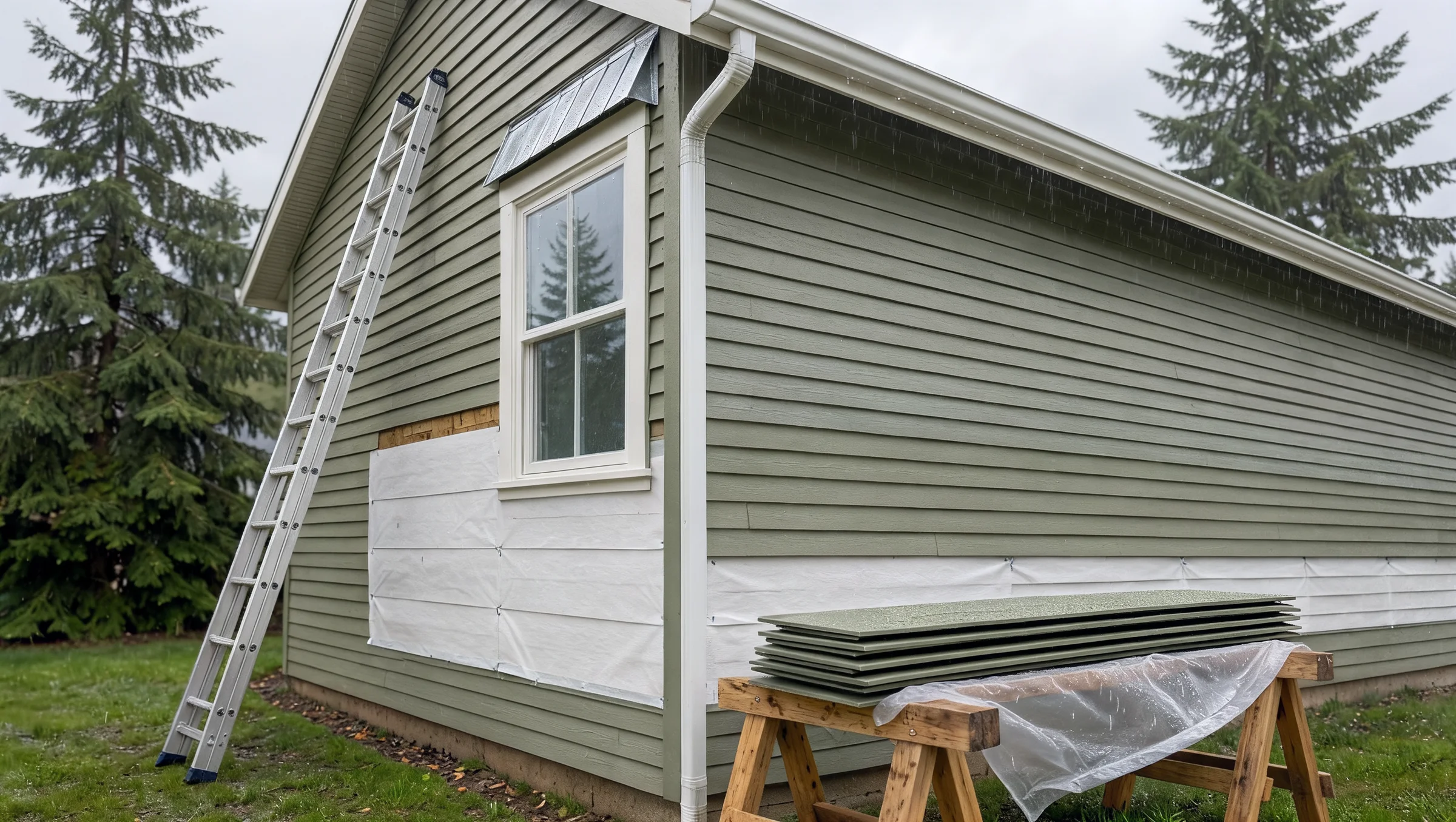
Repair your siding when the damage is limited to a few boards and the wall behind them is dry and solid. Replace it when rot, cracks or leaks show up on several walls, the water barrier behind the siding has failed, or the same spots keep needing repairs. In Bellevue, replacing most siding doesn’t need a permit, but the wall behind it still has to shed water the way Washington’s code requires.
The rainy season is the best time to find out which case you’re in, because water shows you where it gets in. The dry months are the time to fix it.
Repair or replace: how do you decide?
Start with what you can see, then find out how far the water went.
| What you see | Likely cause | Usually |
|---|---|---|
| One or two soft boards near a downspout, deck or soil | Splash-back or boards too close to the ground | Repair those boards and fix the cause |
| Peeling or blistering paint in one area | Moisture behind the paint, or paint past its life | Find the moisture first; then repair and repaint |
| Rot around a window or door | Missing or failed flashing at the opening | Repair the siding and re-flash the opening |
| Soft boards or swelling on several walls | Siding and barrier at the end of their life | Replace |
| Stains or soft drywall inside an exterior wall | Water past the siding into the wall | Open the wall; likely replace that section or more |
| Cracked, warped or loose boards across a wall | Age, movement, fasteners failing | Replace |
| Repairs every year in the same places | The water path was never fixed | Replace, with new flashing and barrier |
These are typical patterns, not a diagnosis. The deciding factor is almost always what’s behind the boards, and you only learn that by opening a section.
How do you check siding for rot in the rainy season?
Check where water collects or runs, during or right after a rain. Rot rarely starts in the middle of a wall.
- Above and below windows and doors. Look for soft trim, gaps in the caulk, and stains under the sill. The head of a window should have flashing that sheds water outward.
- Where a roof meets a wall. A wall next to a lower roof, a dormer or a porch roof takes a lot of water. If you see stains here, read our guide to roof leaks in the rainy season too, since the problem may start at the roof flashing.
- The bottom courses. Boards close to soil, mulch, a patio or a deck stay wet. Siding manufacturers specify gaps above the ground, roofs and decks for this reason.
- Behind gutters and downspouts. An overflowing gutter or a loose downspout can soak one patch of wall all winter.
- Around pipes, vents and lights. Every hole through the siding needs a seal or a flashing block.
- Press and probe. Push gently on suspect boards and trim with a screwdriver. Firm wood is fine; wood that gives or crumbles is rot.
- Look inside. Check the inside face of exterior walls, the attic edges and the basement or crawlspace rim for stains or a musty smell.
Take photos; where the damage is tells a contractor more than how bad one board looks.
What’s behind the siding, and why does it matter?
Siding is the first layer, not the only one. Behind it there should be a water-resistive barrier (house wrap or building paper), flashing at every window, door and roof edge, and a path for water that gets past the siding to drain back out.
Washington amends the national residential code on this point. Its rule says the exterior wall “shall be designed and constructed in a manner that prevents the accumulation of water within the wall assembly” by providing a water-resistive barrier behind the siding “and a means of draining water that enters the assembly to the exterior” (WAC 51-51-0703, R703.1.1, checked November 2026).
The same section notes that lapped siding made of plywood, engineered wood, hardboard or fiber cement doesn’t need an air-gap cavity, but it still needs the barrier. Fiber-cement lap siding must overlap at least 1¼ inches and be installed “in accordance with the manufacturer’s installation instructions.”
This is why a patch can fail: if the barrier is torn or the window was never flashed, new boards won’t stop the leak. A full replacement lets the whole layer underneath be inspected and redone.
Which siding material holds up in the Pacific Northwest?
All of the common materials can last here when they’re installed and maintained well; they differ in upkeep, weight and how they handle water.
| Material | Strengths | What to watch |
|---|---|---|
| Fiber cement | Doesn’t rot; holds paint well; fire-resistant | Heavy; cut edges and joints need sealing; must follow the manufacturer’s clearances |
| Cedar | Natural look; easy to repair one board | Needs regular paint or stain; rots where it stays wet |
| Engineered wood | Lighter than fiber cement; long boards | Paint and cut edges must stay sealed; swelling where water sits |
| Vinyl | No painting; low cost to maintain | Can crack in cold and distort from heat; fewer color changes later |
For a partial repair, matching matters more than material: use the same material and profile, ideally on a full wall from corner to corner.
Do you need a permit to replace siding in Bellevue?
Usually not. The City’s rule is short: “A permit is not required for the replacement of siding, except for stucco and brick or stone veneer greater than four feet above the grade plane” (Work Requiring Permits, checked November 2026).
Two related jobs often come up during a re-side:
- Windows and doors. Replacing a window or door with the same size in the same spot needs no permit. Installing a new one, moving one or making a window wider needs a permit with plan review.
- Damaged sheathing or framing. If rot has reached the wall sheathing or studs, the repair is structural. Ask the City whether it needs a permit before that part of the wall is closed. Our Bellevue permit guide explains the permit types.
Rules change, so confirm your project with the City before work starts.
What if your house was built before 1978?
Old paint on siding and trim may contain lead. The EPA’s Renovation, Repair and Painting (RRP) rule requires certified firms and lead-safe practices for paid work that disturbs “more than 20 square feet on the exterior” of a pre-1978 home. Window replacements are covered too. The rule “does not impose requirements on homeowners,” but the firm you hire must be certified (EPA, RRP Rule FAQ, checked November 2026).
Expect plastic on the ground, contained cutting and careful cleanup. Our guide to remodeling an older Bellevue home covers lead, asbestos and Washington’s certification rules.
When should you schedule siding work?
Inspect and plan in winter; install in the drier months. A small repair can be done in a dry spell, but a full re-side leaves a wall’s barrier exposed for days, and paint needs dry weather to cure.
A practical schedule:
- November to February: walk the house in the rain, take photos, fix gutters and downspouts, and get the wall opened where you suspect rot.
- February to April: get quotes, choose a material and color, and order materials.
- Late spring to early fall: replace siding and paint. Our guide to when you can paint the exterior covers the temperatures and dry time paint needs.
If water is getting inside now, don’t wait for summer. A temporary repair can protect the wall until the full job.
Common questions
Can I replace only a few siding boards? Yes, if the damage is local and the barrier behind those boards is intact. Fix the cause too, such as a downspout, missing flashing or soil against the wall, or the same boards will rot again. If you can’t find matching boards, replace a full wall section from corner to corner.
Is it OK to install new siding over old siding? Covering old siding hides whatever is wrong behind it, and it adds thickness at every window and door, which complicates the flashing. In our region, removing the old layer is the way to inspect the barrier and fix rot before it spreads.
Do I need a permit to replace siding in Bellevue? Not for most siding. Stucco and brick or stone veneer more than four feet above grade need a permit, and new, moved or larger windows need a permit with plan review.
Plan your siding project with us
We give free on-site estimates for roofing and siding in Bellevue and the Eastside. We look at the boards, the flashing at windows and roof edges, and the wall behind the damage, then give you a written, itemized quote that says whether we recommend repair or replacement and why. Request your free estimate.