
Planning
Should You Repair or Replace Your Deck? Bellevue, WA Guide
Decide whether to repair or replace your deck in Bellevue, WA: a rainy-season rot checklist, the city's permit rules and what a rebuild must meet.
By Shawn, True Level Remodeling阅读中文版
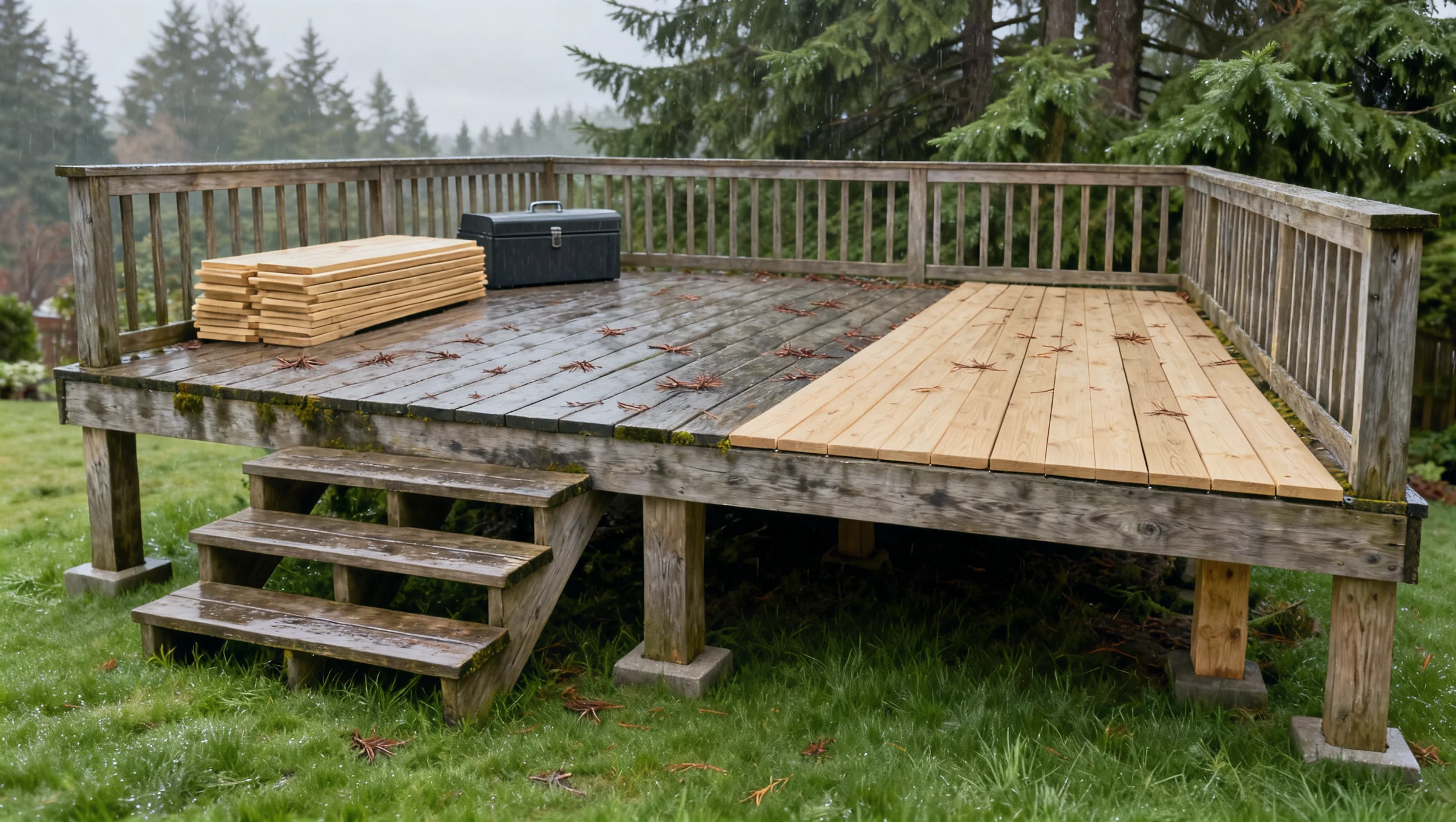
Repair a deck when the problems are on the surface and the framing underneath is sound: worn boards, a loose railing, a wobbly stair. Replace it when rot has reached the ledger, joists, beams or posts, because new boards on weak framing don’t fix the part that holds you up.
In Bellevue, that line also decides the permit. Fixing boards, rails or stairs uses a simple permit; repairing the framing or building a new deck needs plans and city review.
Repair or replace: how do you decide?
| What you find | Usually | Bellevue permit (deck over 30 inches high) |
|---|---|---|
| Worn, cupped or split boards; framing is solid | Repair: replace boards | No-plan-review permit |
| Loose or low guardrail, wobbly handrail | Repair: rebuild the rail | No-plan-review permit |
| Soft or cracked stair treads or stringers | Repair: rebuild the stairs | No-plan-review permit |
| Rot in one or two joist ends | Repair: sister or replace joists | Plan review |
| Ledger soft, stained or pulling away from the house | Often replace | Plan review |
| Rot in several joists, a beam or the posts; deck sways | Replace | Plan review |
| Deck under 30 inches above the ground | Either | No building permit |
These are typical patterns, not a diagnosis. A contractor who opens up the problem areas can tell you which row you’re in.
How do you check a deck for rot?
Start at the house and work outward, because the most important connection is the one you can’t see from the yard. The rainy season is the best time to look: water shows you where it collects.
- The ledger. This is the board bolted to the house that carries one side of the deck. Look from below for dark staining, soft wood, rusty bolts, or a gap between the ledger and the wall. Washington’s code requires ledgers to be flashed “to prevent water from contacting the house band joist” (WAC 51-51-0507, checked November 2026). Older decks often have no flashing at all, and the rot can spread into the house framing.
- Joists and beam ends. Push a screwdriver or awl into the ends of joists and beams, and anywhere water drips. Sound wood resists; rotted wood lets the tip sink in or comes out in soft fibers.
- Posts and footings. Check where posts meet the ground or concrete. Rot at the base, posts sitting directly in soil, or footings that have settled are structural problems.
- Boards. Soft spots, boards that bounce, and gaps packed with needles and moss that keep the wood wet.
- Rails and stairs. Push on the guardrail at the posts. It shouldn’t move. Check stair stringers where they touch the ground.
- Fasteners and hangers. Rusted joist hangers, nails and screws lose strength even when the wood looks fine.
Stop using the deck if the ledger is pulling away from the house, a post has moved, or the deck sways when you walk on it. Those are signs the structure itself is failing.
What permits does Bellevue require for deck work?
It depends on how high the deck is and whether the framing is involved. According to the City of Bellevue:
- Under 30 inches: “A permit is not required for installing or repairing a deck that is less than 30 inches above the ground” (Work Requiring Permits, checked November 2026).
- Boards, rails and stairs: “Repairing an existing deck or porch guardrail, handrail, stairs or deck boards” qualifies for the building permit with no plan review, which can often be issued the same day. The same page adds: “repairing framing members, such as joists or beams, requires plan review” (Building permits, no plan review, checked November 2026).
- Framing repairs and new decks: the single-family addition permit covers “building a deck or deck with spa” and “repair or replacement of existing deck structural framing.” It needs plans and plan review (Single-Family Addition Permit, checked November 2026).
Bellevue’s Permit Processing Timelines report doesn’t list decks separately. The addition-permit category they fall under had a median review of about 11 weeks over the past year, but that figure includes whole house additions, so a straightforward deck may move faster. Plan for weeks, not days.
Any rebuilt railing has to meet the guard rules the City lists: guards wherever the walking surface is more than 30 inches above grade, at least 36 inches high, with openings small enough that a 4-inch sphere can’t pass through. Our Bellevue permit guide covers other outdoor work.
Why isn’t a rebuilt deck a copy of the old one?
A replacement deck is built to today’s code, not to the code your old deck was built under. Washington amends the national deck rules, and the differences show up in the design:
- The state’s own span tables. Washington doesn’t adopt the national beam span tables and uses its own, based on a 60-pound-per-square-foot live load (WAC 51-51-0507). Beam and joist sizes, post sizes and footing sizes all follow from those tables or from an engineer’s design.
- Flashed ledgers. As above, the ledger must be flashed so water stays off the house framing.
- Decking decides joist spacing. “The maximum joist spacing shall be limited by the decking materials” (WAC 51-51-0507). Many composite boards need joists closer together than an old wood deck had, so new boards on old framing may not fit the rules.
That’s why replacing a deck often means new footings, posts and framing in the same footprint, not just new boards.
Wood or composite for the new surface?
The surface is a choice; the framing underneath is still wood in most decks. Pressure-treated framing with corrosion-resistant fasteners and hangers does the structural work either way.
- Wood boards (pressure-treated or cedar) cost less up front and can be refinished, but need regular cleaning and sealing in our wet climate.
- Composite or PVC boards need less upkeep and don’t rot, but they need the joist spacing their maker specifies, and they still need cleaning to keep moss and grime off.
Whichever you choose, keep the deck surface clear of needles and leaves so water can drain and the framing can dry.
When should you repair or rebuild a deck in the Seattle area?
Inspect now, plan over the winter, build when it’s dry. Fall and winter rain shows you where water sits and which boards stay soft. If a rail or stair is unsafe, fix it right away; that’s a small permit and a short job.
For a rebuild, use the winter for design and plan review, so work can start as the weather dries out in spring. Concrete footings, framing and new boards go in faster and cleaner in dry weather, and stain or sealer on wood boards needs dry days to cure, the same constraint we cover for exterior painting.
Common questions
Can I just replace the deck boards? Yes, if the joists, beams, posts and ledger are sound and the new boards suit the existing joist spacing. If the framing has rot, new boards hide the problem instead of fixing it.
Do I need a permit to replace deck boards in Bellevue? If the deck is under 30 inches above the ground, no. If it’s higher, replacing deck boards qualifies for the permit with no plan review. Repairs to joists or beams need plan review.
Can composite boards go on my old wood framing? Only if the framing is in good condition and the joists are spaced as the composite maker requires. Washington’s code ties joist spacing to the decking material, so check before ordering.
Plan your deck with us
We give free on-site estimates for decks, fences and landscaping in Bellevue and the Eastside. On the visit we check the ledger, framing, posts and rails, tell you whether repair or replacement makes sense, and give you a written, itemized quote that lists scope, permits and schedule line by line. Planning more backyard work? See our guide to pavers, retaining walls and sheds. Request your free estimate.